Veneto

Edited by:
Massimo Martini
Access
Veneto is accessible from the west via the Serenissima motorway, which runs across the entire Po Plain connecting Verona, Vicenza, Padua and the Mestre junction towards Venice. From the north, the Brenner motorway enters the region near Verona, forming the main access corridor from the northern Alpine side; between 15 November and 15 April, winter tyres or snow chains are compulsory. Access to the Belluno Dolomites is via the Mestre–Belluno motorway, which connects to Cortina d'Ampezzo via national road . Rail services are operated by Trenitalia (TI), with main hubs at Verona Porta Nuova, Padua and Venice Santa Lucia; the latter provides direct rail access to the island city. The regional airport system comprises three airports: Marco Polo Airport in Venice-Tessera (main international hub), Valerio Catullo Airport in Verona-Villafranca and Antonio Canova Airport in Treviso. Local public transport networks connect the main municipalities and Alpine valleys; lake ferry services on Lake Garda are operated by Navigazione Laghi.
Introduction
Veneto stretches across the north-eastern corner of northern Italy, from the Dolomite massifs to the Adriatic coast, through a territory encompassing mountain, hilly, lowland and lagoon zones. The region borders Austria and Trentino-Alto Adige to the north, Lombardy to the north-west, Friuli-Venezia Giulia to the east, Emilia-Romagna to the south-west and the Adriatic Sea to the south. The morphology is among the most varied in the country: Dolomite massifs and the Venetian Prealps descend towards volcanic hill formations, a fertile plain crossed by major Alpine rivers and a coastal lagoon system of European significance. For over a millennium the territory gravitated around the Republic of Venice, a commercial and maritime power that left an urban, hydraulic and cultural legacy still visible across the region. Together with Trentino-Alto Adige and Friuli-Venezia Giulia, Veneto forms the geographical and cultural macro-region known as Triveneto.
Description
The Venetian territory is organised into three morphological bands running from north to the sea. The northern section is dominated by the Eastern Alps, with the central Dolomite core and the Venetian Prealps along the southern edge. Among the best-known Dolomite massifs are the Tre Cime di Lavaredo, the Tofane group, the Pelmo, the Civetta and the Marmolada, which at 3,343 metres is the region's highest point and hosts the only significant Dolomite glacier in Venetian territory. The Venetian Prealps include the Asiago Plateau, Monte Grappa and the Monti Lessini, characterised by less vertical morphologies than the Dolomites and a network of hiking and historical trails. The hydrographic network is among the most important in northern Italy: the Adige, Piave, Brenta and Bacchiglione rivers descend from the Alps, crossing the plain to the Adriatic. The eastern shore of Lake Garda, Italy's largest lake, creates a temperate microclimate in the Verona area that supports the cultivation of Mediterranean species such as olive and lemon.
The hill zone is made up of formations of different origins: the Colli Euganei, isolated volcanic hills rising from the plain near Padua, and the Colli Berici south of Vicenza. In the pre-Alpine zone between Conegliano and Valdobbiadene stretches a wine landscape shaped over centuries by agricultural activity, with the characteristic "ciglioni" terraces recognised in 2019 as a UNESCO World Heritage Site under the category Conegliano and Valdobbiadene Prosecco Hills Landscape. The Venetian plain slopes uniformly towards the coast, where sandy beaches alternate with lagoon systems: the Venice Lagoon is the largest lagoonal environment in the Mediterranean, while the Po Delta contains one of the most extensive wetland ecosystems on the peninsula.
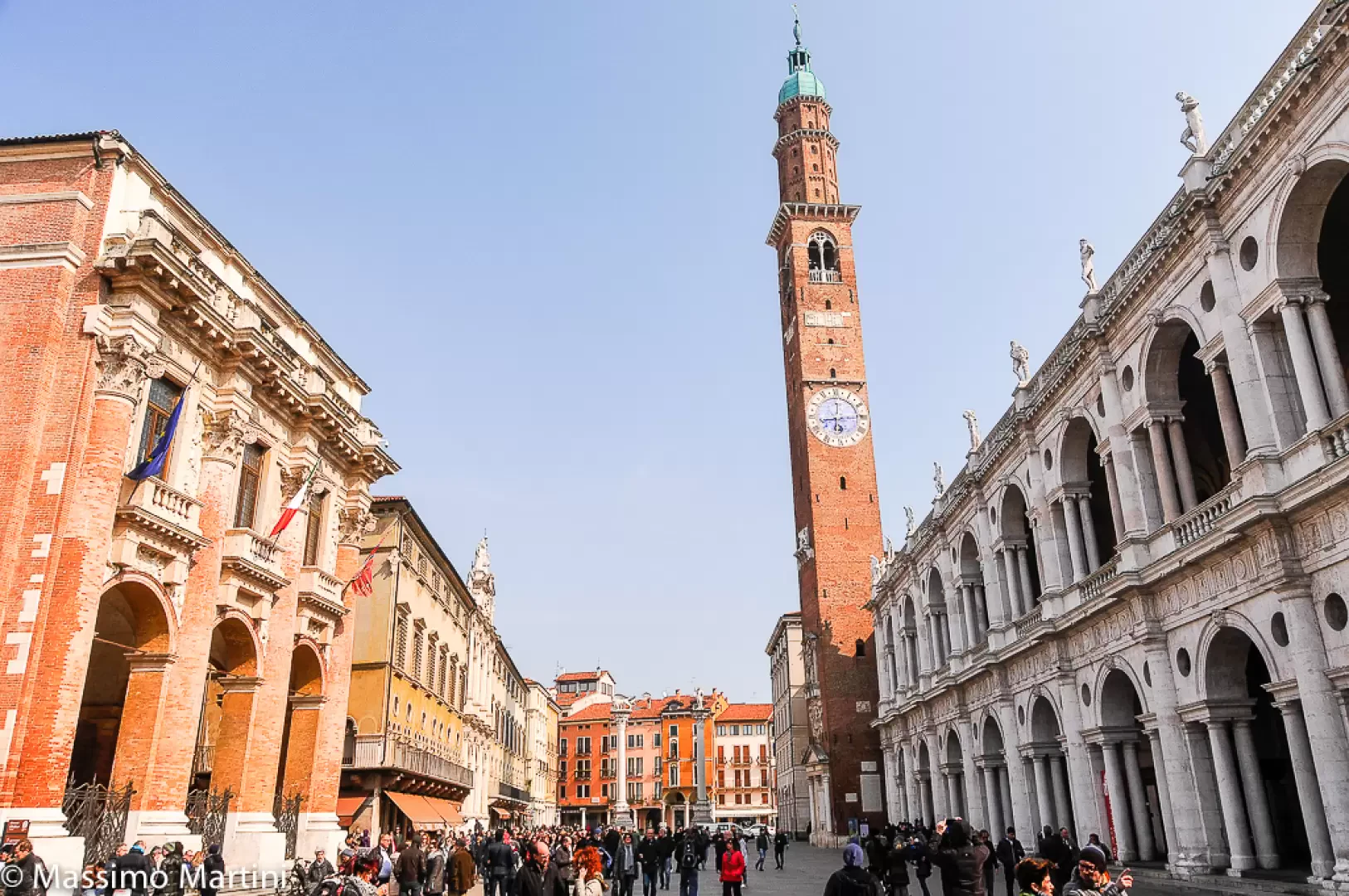
The territory's historical roots reach back to prehistory, when the Veneti people, of probable Indo-European origin, settled the area from the mid-2nd millennium BC, founding settlements such as Padua, Este, Vicenza, Treviso and Verona. Progressive Romanisation led to full Roman citizenship in 49 BC and integration into Regio X Venetia et Histria in the Augustan era. Invasions by the Huns, Ostrogoths and Lombards fragmented the territory between the 5th and 6th centuries, with the lagoon zone maintaining growing autonomy under Byzantine protection until it crystallised, in 697, as the Duchy of Venice. The Republic of Venice controlled European trade routes to the East for more than a millennium, leaving a diverse monumental legacy: Palladian villas scattered across the mainland, fortress cities such as Palmanova and Peschiera del Garda, and hydraulic drainage systems across the plain. The region's historical heritage is recognised by several UNESCO inscriptions: the historic centre of Venice and its lagoon since 1987, the city of Verona since 2000, the Dolomites in 2009 for the geological and landscape value of their nine mountain systems; Padua with its Botanical Garden, founded in 1545 and among the oldest in Europe in its original location, and with the fresco cycle of the Urbs Picta, including the Scrovegni Chapel frescoed by Giotto.
Nature conservation is entrusted to one national park and five regional parks. The Dolomiti Bellunesi National Park, established in 1993 over approximately 31,500 hectares in the province of Belluno, preserves relict flora from the Quaternary glaciations, including Moretti's bellflower (Campanula morettiana) and the Tyrolean primrose (Primula tyrolensis), as well as populations of chamois (Rupicapra rupicapra), red deer (Cervus elaphus) and roe deer (Capreolus capreolus), with increasing presence of wolf (Canis lupus) and lynx (Lynx lynx). The Dolomiti d'Ampezzo Regional Natural Park protects the Tofane and Cristallo massifs. The Colli Euganei are protected by a regional park encompassing the thermal spa areas of Abano Terme and Montegrotto Terme. The Po Delta Regional Park, recognised as a UNESCO Biosphere Reserve under the MAB (Man and the Biosphere) programme, preserves one of Italy's most extensive wetland ecosystems. The system is completed by the Lessinia Regional Natural Park and the River Sile Regional Natural Park.
The regional economy rests on a polycentric productive structure where historically established manufacturing specialisations coexist with internationally recognised agricultural vocations. The eyewear district in the province of Belluno, the tanning district in the Vicenza area and the fashion districts in the Treviso area form manufacturing clusters of European scale. Agriculture is characterised by denomination-certified productions: Prosecco di Conegliano Valdobbiadene DOCG, Soave and Amarone della Valpolicella wines, Asiago DOP cheese, and Radicchio di Treviso IGP. Tourism generates a significant contribution to the regional added value, with flows concentrated in Venice, art cities, Lake Garda, the Adriatic coast and the Belluno Dolomites.
The Dolomites' High Routes are the reference itineraries for long-distance Alpine trekking: High Route No. 1 connects Lago di Braies to Belluno in twelve stages through the central Dolomite core, with passages at the Tofane and the Lagazuoi Refuge; High Route No. 2 crosses the Sella and the Pale di San Martino from Bressanone to Feltre; High Routes No. 3, 4 and 5 develop across the eastern massifs of the Sorapiss and the Antelao. The Cammino delle Dolomiti covers a thirty-stage loop of approximately 500 kilometres across the entire province of Belluno, passing through sanctuaries, villages and places of memory including the birthplace of Pope Luciani in Canale d'Agordo. The Cortina d'Ampezzo area concentrates the ski touring offer with hut-to-hut traverses retracing the summer routes. The historic Calalzo–Cortina railway line has been converted into a cycling path running through the Belluno valleys.
Venetian mountaineering took root in the second half of the nineteenth century, when British and German explorers opened the first routes on the Dolomite massifs: John Ball made the first documented ascent of the Pelmo in 1857 via the ledge that still bears his name, while Paul Grohmann systematically climbed the Tofane, the Sorapiss and the Marmolada in the following decade. The decisive technical leap came on 7 August 1925, when Emil Solleder and Gustav Lettenbauer traced the direct line on the North-West face of the Civetta, codified as the first sixth-grade route in the Alps. In the 1930s, Emilio Comici introduced the principle of the "falling drop line" — the purest vertical line from bottom to top — opening routes on the Tre Cime di Lavaredo that redefined the technical standards of the discipline. The walls of the Civetta and the Marmolada remain today absolute references for high-standard alpinism in the Venetian Dolomites.
Trail running finds in Veneto one of its national reference territories. The Lavaredo Ultra Trail, starting and finishing in Cortina d'Ampezzo, offers distances from 10 to 120 kilometres through the Sesto Dolomites and the Ampezzo basin, with the night-time passage at the Tre Cime di Lavaredo as the iconic moment of the main race; the event is part of the UTMB World Series circuit and draws athletes from over eighty nations. The Dolomiti Extreme Trail in Val di Zoldo offers distances of up to 103 kilometres on technical Dolomite terrain, with cumulative elevation gains among the highest in the national landscape. The Transpelmo, centred on the Pelmo massif, is a skyrunning reference with the crossing of Forcella Val d'Arcia at 2,476 metres.
Information
General data
Regional capital: Venice
Area: 18,390 km²
Minimum altitude: 0m (Adriatic coast)
Highest point: 3,343m – Marmolada
Population: 4,855,123 (as of 01.01.2025)
Inhabitants: Venetians
Name in dialect: Vèneto
Provinces and metropolitan city: Province of Belluno – Province of Padua – Province of Rovigo – Province of Treviso – Metropolitan City of Venice – Province of Verona – Province of Vicenza
Municipalities: 560 – list - map
Bordering regions and territories: Emilia-Romagna – Friuli-Venezia Giulia – Lombardy – Trentino-Alto Adige (Italy); Austria
Country: Italy
Official website: https://www.regione.veneto.it