Cho Oyu

Edited by:
Massimo Martini
Access
Summit Routes
Cho Oyu is reached almost exclusively from the Tibetan side, where the standard route follows the north-west face, retracing the path taken by the first ascenders in 1954. The base camp, at an altitude of around 5,700 metres, can be reached by jeep from Tingri via the Tibetan track, requiring only one or two additional days’ walking: this logistical advantage is what sets Cho Oyu apart from the other eight-thousanders and is a key factor in its popularity. From base camp, the route ascends the glacier and tackles the north-west face via a series of camps — typically three — with the last one set up at around 7,400–7,500 metres. The final section, over snow and ice with moderate gradients, leads to the summit. The standard route does not present technical difficulties comparable to those of other eight-thousanders and does not require rock climbing at high altitude. On the Nepalese side, the south-east face offers a completely different route, of high technical difficulty, first ascended in 1978 by an Austrian couple.
Summer routes
» from Tibetan Base Camp (5,700 m), via the north-west face – PD – 4–6 weeks (including acclimatisation) – (2,488 m elevation gain) (standard route, Tibetan side)
» from the Nepalese Base Camp, via the south-east face (1978, Koblmüller and Furtner) – ED – a highly technically demanding route on the Nepalese side
» from the Tibetan Base Camp, via the Messner route (1983) – D – new route opened by Reinhold Messner during his fourth expedition to the mountain)
» from Tibetan Base Camp, new south-east face route (2009, Urubko and Dedeshko) – ED – Piolet d'Or 2010
Winter ascents
’ via the normal route (5,700m) – PD – first winter ascent 12 February 1985 (mountaineering, Berbeka and Pawlikowski)
Introduction
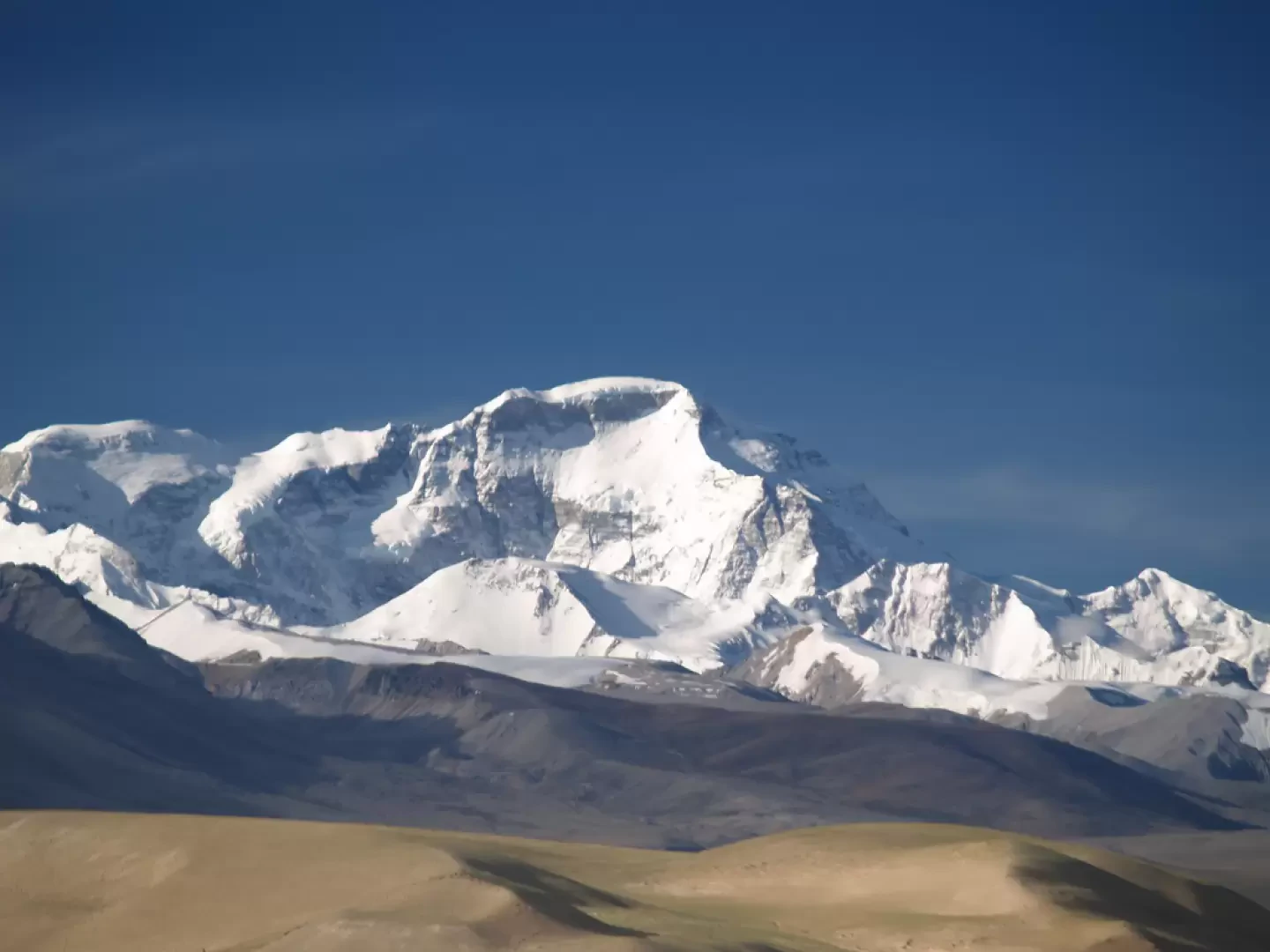
At 8,188 metres, Cho Oyu is the sixth-highest mountain on Earth. It rises in the central section of the Himalayan range, on the border between Nepal — in the Khumbu region — and Chinese Tibet, some 20 kilometres north-west ofEverest, with which it shares the Nangpa La (5,716 m), a pass historically used by trade caravans between Tibet and Nepal. The Tibetan name Cho Oyu means ‘goddess of turquoise’, referring to the blue-green colour of its ice faces as seen from the Tibetan plateau. The first ascent was made on 19 October 1954 by the Austrians Herbert Tichy and Joseph Jöchler, accompanied by the Sherpa Pasang Dawa Lama, as part of a small private expedition with a budget of around one-sixteenth of that of the major Italian expedition which, thathad conquered K2 that year: the three climbed without supplementary oxygen via the north-west face, reaching the highest altitude ever attained by human beings without the aid of oxygen cylinders, a record that would remain unbroken until the oxygen-free ascent ofEverest by Reinhold Messner and Peter Habeler in 1978. Cho Oyu is considered the most accessible of the eight-thousanders due to its relatively moderate standard route and the fact that its base camp is accessible by vehicle from Tibet; these features make it the most popular mountain over 8,000 metres afterEverest and a favoured destination for those approaching extreme high altitude for the first time. The first winter ascent was made on 12 February 1985 by Maciej Berbeka and Maciej Pawlikowski, as part of the Polish school of winter Himalayan mountaineering.
Description
Geographical context
Cho Oyu dominates the border region between thethe Nepalese Himalayas and the Tibetan plateau, in a position that gives it distinct geographical and climatic characteristics compared to the more easterly eight-thousanders. To the east, beyond the Nangpa La, lies the Khumbu Valley with the pyramid-shaped peak of Everest clearly visible; to the west, the Himalayan ridge descends towards Gaurishankar (7,134 m) and the peaks of central Nepal. The north face looks directly out onto the Tibetan Plateau, characterised by cold, powerful winds that descend from higher altitudes but which — paradoxically — make the Tibetan base camp more stable and accessible than the Nepalese ones. The mountain has a relatively massive shape, with the main summit flanked by a north-western shoulder and a series of spurs descending towards the surrounding glaciers.
Geologically, Cho Oyu belongs to the Greater Himalayas, with predominantly crystalline rocks — granites, gneiss and mica schist — of Precambrian and Palaeozoic origin, uplifted and metamorphosed by the collision between the Indian and Eurasian plates. The upper slopes are covered by a continuous glacial mantle, meaning that the ascent along the normal route takes place almost entirely on snow and ice. The Nangpa La, the 5,716-metre pass separating Cho Oyu fromEverest to the east, has for centuries been one of the Himalayas’ main trade corridors, travelled by caravans of yaks carrying salt, wool and Tibetan goods to Nepal and back.
The flora and fauna in the Cho Oyu area reflect the dual influence of the Himalayan ecosystem and that of the Tibetan Plateau. On the Nepalese side, forests of rhododendrons, firs and junipers extend to over 4,000 metres; on the Tibetan side, the vegetation is more steppe-like, with water-lentil pastures and dwarf shrubs. The snow leopard (Panthera uncia) inhabits the mid-altitude slopes on both sides of the border.
Mountaineering history
The first reconnaissance expeditions to Cho Oyu date back to 1951, when the British expedition led by Eric Shipton — with Edmund Hillary, Tom Bourdillon and Charles Evans amongst the participants — explored the Nangpa La and the mountain’s slopes. The following year, the same expedition returned with a more direct objective, but failed to identify a viable route of ascent and was forced to abandon the attempt. In 1954, whilst the great Italian expedition was conquering K2, the Austrian doctor and writer Herbert Tichy organised a small private expedition on a very tight budget — around 1,500 dollars at theat the time — and with a philosophy of minimalism that anticipated the alpine approach to high altitudes by decades. On 19 October 1954, Tichy, Jöchler and the Sherpa Pasang Dawa Lama reached the summit via the north-west face, without supplementary oxygen, setting the highest altitude ever reached without oxygen tanks up to that point: 8,188 metres. The feat, recounted by Tichy in the book “Cho Oyu — My Lady of Turquoise”, became a seminal work in post-war mountaineering literature.
In 1958, the second ascent was achieved by an Indian expedition, with Pasang Dawa Lama once again reaching the summit — his second time on top of the same eight-thousander, which was extraordinary at the time. In 1959, an ill-fated international all-female winter expedition claimed the lives of four female mountaineers. In 1978, the Austrians Eduard Koblmüller and Alois Furtner opened a route on the challenging Nepalese south-east face. From 1978 onwards, Reinhold Messner visited Cho Oyu on numerous occasions: in 1983, during his fourth expedition to the mountain, he opened a new route. In 1984, the first female ascent was achieved by the Czechoslovakian climbers Věra Komárková — who had previously made the first female ascent of Annapurna in 1978 — and Dina Štěrbová.
The first winter ascent was made on 12 February 1985 by Maciej Berbeka and Maciej Pawlikowski, as part of a Polish expedition led by Andrzej Zawada. Three days later, on 15 February, Jerzy Kukuczka and Andrzej Heinrich repeated the ascent, with Kukuczka thus achieving the second winter ascent of two eight-thousanders in the same season — a record that no one has since equalled. That same winter, Kukuczka also opened the South Buttress, the first new route established on an eight-thousander during the winter season.
On 30 September 2006, a dramatic incident marked the recent history of Cho Oyu: at Nangpa La, the pass between Tibet and Nepal used by Tibetan refugees attempting to reach Nepal, a Chinese military patrol opened fire on a group of civilians. The incident was filmed by mountaineers at Cho Oyu base camp and the footage, which was broadcast internationally, sparked a diplomatic row. In 2009, Denis Urubko and Boris Dedeshko opened a new route on the south-east face, an ascent that was awarded the 2010 Piolet d’Or. The first complete ski descent from the summit was achieved on 30 September 2013 by the Italian Mario Monaco.
Cultural context
The Nangpa La, which opens out at the foot of Cho Oyu, is one of the most historically significant Himalayan passes: used for centuries by Tibetan merchants trading with the Sherpa communities of the Khumbu, it became an escape route for Tibetan refugees in the 20th century. The incident in 2006, in which Chinese soldiers opened fire on Tibetan civilians whilst mountaineers from around the world watched from base camp, transformed Cho Oyu into a landmark not only for mountaineering but also for politics. The name ‘goddess of turquoise’ reflects the Tibetan tradition of identifying great mountains as the abodes of protective female deities, similar to the conception of Kangchenjunga in Sikkim. The mountain is considered one of the most ‘benevolent’ in the Himalayas — insofar as this word can be applied to an 8,188-metre peak — and this character is reflected in the number of climbers who tackle it, making it a sort of gatewayto the world of eight-thousanders for generations of mountaineers who tackle its normal route as their first experience of extreme high altitude.
Access and popularity
Cho Oyu is the second most popular eight-thousander in the world after Everest, with hundreds of mountaineers per season in spring and autumn. Access from the Tibetan side, the technically moderate standard route and the possibility of reaching base camp by vehicle make it the preferred entry point for those wishing to experience altitudes above 8,000 metres. Climbing permits are issued by the Chinese authorities. The main weather windows are in spring (April–May) and autumn (September–October), with the autumn window being particularly popular. Although there is a mortality rate, it is significantly lower than that of the other eight-thousanders.
Support
’ Tibetan Base Camp (5,700 m) — accessible by jeep from Tingri
Information
Elevation: 8,188 m
Alternative name: Cho Oyu = “goddess of turquoise” (Tibetan)
Mountain range: Central Himalayas — Mahalangur Himal
Mountain range: Himalayas
Type: pyramid / main summit
Protected area: Sagarmatha National Park (Nepalese side) / UNESCO World Heritage Site
First ascent: 19 October 1954
First ascenders: Herbert Tichy, Joseph Jöchler, Pasang Dawa Lama
First winter ascent: 12 February 1985
First winter ascenders: Maciej Berbeka, Maciej Pawlikowski
Summit book: none
Municipality/ies: Solukhumbu (Nepal) / Tibet (China)
Valley/ies: Khumbu Valley (Nepal); Tibetan Plateau (China)
Climbing difficulty: PD (normal route); ED (south-east face)
Average elevation gain: 2,488 m (from Base Camp)
Recommended period: April–May; September–October
Predominant exposure: N-W (standard route); SE (Nepalese side)
Glaciers: yes
Equipped sections: yes (fixed ropes on the standard route)